of irrigation and empire: how geopoliticS started with water management
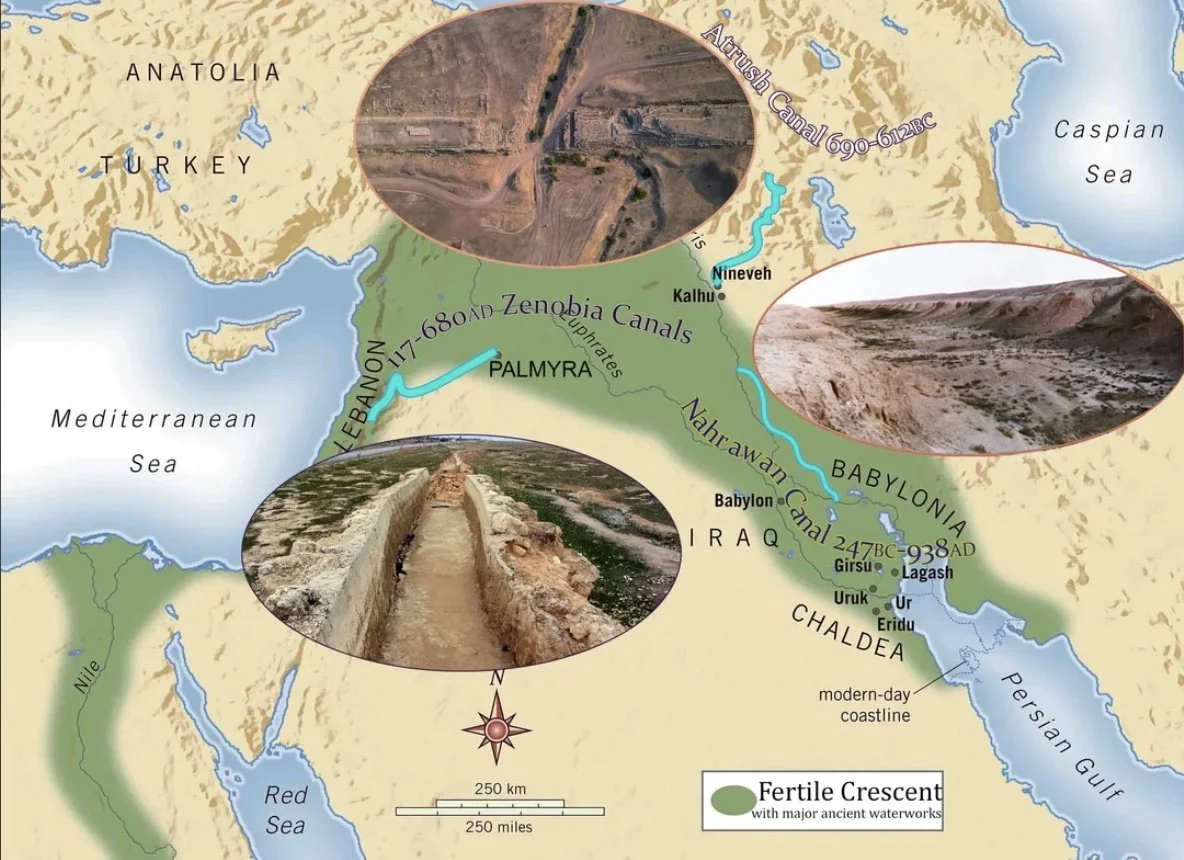
Major irrigation projects in the ancient world as the roots of political power
Civilization, as defined by historians and archaeologists, begins with densely populated areas where survival relies on systems of cooperation, specialization, and control. Primary sources show that the hallmarks of civilization, often identified as cities of 5,000 people or more, first appeared in Egypt and Mesopotamia as early as 3,000 B.C.
These societies, collectively known as “the cradle of civilization,” both had access to major river systems—the Nile in Egypt and the Tigris and Euphrates in Mesopotamia. Was it access to rivers that triggered the early development of these societies by forcing them to develop systems to control the waters? And once these systems were in place, could they have been the driving force for the development of laws and statehood to such an extent that these areas would one day be called “the cradle of civilization” and, indeed, go on to form the first major world empire?
Certain aspects of the answer to these questions seem straightforward. For example, since humans need food and water to survive, then early humans would have naturally been drawn to rivers—just like animals—because they provided clean drinking water, hunting grounds, and eventually opportunities for farming. It stands to reason that at least a spark for early settlements would have been determined by river access.
It also seems intuitive that once basic needs were fulfilled in these early settlements, the inhabitants would socialize and increase their numbers. As the settlements expanded, so would the demand for food and water. However, this was the case in many regions around the world during the third millennium B.C. What was it about Egypt and Mesopotamia specifically that enabled their societies to advance further with the development of law and statehood? Given that Mesopotamia and Egypt had similar riverine environments, could it have been the mechanisms of hydraulic control, like canals and dams, that promoted these progressions? Or was it something else?
This paper argues that the need to control river water for irrigation—driven by the unique semi-arid climates of Mesopotamia and Egypt—was the main driving force behind the development of their political, legal, and technological systems. In these regions, irrigation was not just about watering crops; it was essential for prosperity, requiring a managed infrastructure. This infrastructure increased agricultural output, which in turn attracted more people, ultimately leading to the creation of laws, bureaucracies, and engineering achievements to support a burgeoning population. These systems were not only responses to environmental challenges but also catalysts for social complexity, state formation, and, eventually, empires.
To support this thesis, the paper will first examine the environmental contexts in Mesopotamia and Egypt that made hydraulic management necessary. It will then explore the technological innovations that emerged from this need, followed by an analysis of the legal and political systems that evolved to govern water use. Economic and labor implications will also be considered, along with counterexamples and limitations to the thesis. Finally, the conclusion will revisit the hypothesis in light of the evidence, acknowledging any necessary adjustments and reflecting on the lasting legacy of ancient water systems and their relevance to modern civilization.
Environmental Conditions in Mesopotamia and Egypt
Mesopotamia, often called the “Fertile Crescent,” was situated between the arcs of the Tigris and Euphrates rivers. The word “Mesopotamia” comes from Greek, meaning “between the rivers.” The Euphrates begins where these two rivers meet in south-central Turkey and flows through valleys and gorges until it crosses into Syria and enters the lower Mesopotamian floodplain. The Tigris is shorter but has a deeper channel, which allows ships to travel. The Tigris and Euphrates eventually flow into a permanent marshy lake to form the Shatt al-Arab waterway, which empties into the Persian Gulf at the present-day Iraqi city of Basra. Farmers and fishermen first settled in Mesopotamia around 5,500 B.C. By the fourth and third millennia B.C., the Fertile Crescent included the kingdoms of Sumer, Akkad, and Assyria.
The Nile River stretches about 4,135 miles from Lake Victoria in Uganda to the Mediterranean Sea in Egypt. Despite its great length, Egyptian civilization began in the late fourth millennium B.C. in a concentration along the Nile River Valley, near what is now Cairo. Scholars debate the true origin of organized agriculture in Egypt. Early radiocarbon dating shows that livestock first appeared in Egypt several thousand years after Mesopotamia. However, new evidence and advances in dating methods indicate that unique agricultural practices in the Nile Valley existed as early as the sixth millennium B.C.[1]
Both regions had soil enriched by the flow of silt, which resulted in fertile land suitable for farming. One indicator of soil quality is its pH, or “potential of hydrogen.” A soil’s pH influences nutrient availability, with optimal ranges varying by crop. For example, plants such as blueberries require a pH of 4.5-5.5. Vegetables need a pH of 6.0-6.8, and alkaline-tolerant plants like lavender and herbs thrive in soil with a pH of 7.0-8.0. Fed by the Euphrates, Mesopotamian soil is considered fertile because of its balanced 6.0-7.0 pH and loamy texture, which promotes good drainage, aeration, and water retention. Similarly, the soil in the Nile Valley is enriched by predictable annual flooding that deposits nutrient-rich silt across the floodplain. The Nile Valley’s soil tends to be more acidic, with a pH between 7.0 and 8.0, and also features a silty-loam texture that improves moisture retention and aeration. Since wheat tolerates a pH of 6.0-7.5, both regions possessed ideal soil characteristics for cereal crops.[2]
However, despite the rich soil, the climate conditions in each region (then and now) pose distinct challenges to agriculture. In Iraq, the site of ancient Mesopotamia, average summer temperatures often exceed 120°F. Winter temperatures drop to freezing levels, with a monthly average of 50°F. Heavy rains in January occur when it is too cold to improve crop growth (although they can also cause floods, which improve soil). Rains that occur later in the year, when the temperature warms, are too late to affect crop size.[3]
In Egypt, average summer temperatures range from 95°F to 104°F, and the growing season is longer because winter temperatures do not drop below 41°F. However, annual rainfall is even more limited than in Iraq, averaging less than 25 mm per year, mostly during the winter months. The Nile's environmental reliability enabled more consistent agricultural cycles, but rainfall scarcity still poses significant challenges for agriculture.
Both the Nile Valley and Mesopotamia are classified as desert/hot steppe regions under the Köppen-Geiger climate classification system.[4] These climates are characterized by precipitation levels between 20% and 50% of potential evapotranspiration, meaning rainfall is insufficient to support vegetation without supplemental water.[5] In Mesopotamia, the rain fell in a heavy wet season that was inconsistent with crop growth; in Egypt, rain was scarce. Hence, conditions requiring irrigation were ripe in both geographical areas, where the rivers enriched the soil, but the precipitation was incompatible with farming. Irrigation was the key to bridging the gap.
Innovations in Irrigation
Early Mesopotamian farmers struggled to coexist with the rivers that sustained them. The Tigris and Euphrates swelled with mountain snowmelt in the spring, which coincides with the region’s wet season. When the rivers overran their banks, they destroyed settlements and ruined crops. But they also deposited enriched soil, which gave the Fertile Crescent great potential for agriculture. Mesopotamian flood narratives are evident as a defining feature of culture, as noted in the Epic of Gilgamesh, and are later echoed in the Book of Genesis in the Noah story.
Similarly, ancient Egypt also experienced floods that enriched the soil, but they differed in timing, scope, and regularity from those in Mesopotamia. Every year, the Nile overflowed its banks in May and receded in September. While the floods were predictable, their sizes were not, which could lead to devastation for early farmers. If a flood exceeded the optimal level, it could ruin crops and settlements. If it fell short, it could cause drought. We know from primary sources that the Egyptians were concerned about flood levels, as evidenced by their development of devices called nilometers, which were used to monitor, forecast, and communicate the size of each flood. Although archaeological evidence of the earliest devices is limited, inscriptions mentioning nilometers date back to the third millennium B.C. Furthermore, an Egyptian relief sculpture from around 3,100 B.C. depicts a king ceremoniously cutting a ditch in a grid network, confirming that the Egyptians began practicing some form of water management for agriculture around the third millennium B.C.[6]
In addition to the development of basins and levees, which could distribute water through gravity, both regions required water-lifting machines to overcome dike walls and reach higher fields to irrigate crops. One such machine, the shaduf, was a counterweighted lever used to raise water, originally developed in Mesopotamia. A primary source mention of the shaduf appears in the legend of Sargon of Akkad, which, like the Epic of Gilgamesh, is preserved on cuneiform tablets.
In the legend, Sargon was abandoned by his mother and lifted into a canal on a floating bed of reeds. He would later go on to unite various kingdoms to form the greater Akkadian realm. Historians date the oral traditions of the legend to around 2,300 B.C., and a shaduf is depicted on a cylinder seal dating to 2200 B.C., indicating that canals and the tools to manage them were in use in that period.[7] Artistic depictions in tombs and reliefs indicate that the shaduf was used in Egypt as early as 1,570 BC.
Although it was later than in Mesopotamia, the Egyptians had been pioneering their own techniques for river management. An early twentieth-century German archaeological excavation discovered the world’s oldest known large-scale dam, Sadd-el-Kafara, which is accompanied by pottery near the dig site that dates to 2,650 B.C. The dam was overcome by a flood during construction, yet it demonstrates advanced engineering through the use of revetment blocks, core fill, and non-mortar techniques.[8]
The immediate effect of these irrigation efforts was an increase in food supply, as shown by the history of wheat. As previously noted, soil pH and drainage conditions enabled wheat production in Mesopotamia and the Nile River Valley. The domestication of wheat, indicated by genome patterns, occurred in the eighth millennium B.C. and marked a major shift in human behavior from hunter-gatherer to settled farmer.
As irrigation systems improved—overcoming flood and precipitation challenges—they allowed for larger cultivated land plots, which contributed to the selection and propagation of non-brittle emmer wheat and eventually free-threshing bread wheat.[9] These genetic changes, supported by archaeobotanical and genomic evidence, were likely sped up by the stability and predictability provided by irrigation. Domesticated emmer wheat spread from the hilly and mountainous regions of the Fertile Crescent into the lowlands of Mesopotamia and farther west into Egypt around 4,000 B.C.[10]
If one accepts that the transition from wild wheat to emmer and ultimately to bread wheat was a direct consequence of sustained water management and environmental control in ancient Mesopotamia and Egypt, then it logically follows that these agricultural advancements would have led to food surpluses. These surpluses, in turn, would support increasing population density and urbanization, as people would be drawn to the geographically constrained yet highly productive landscapes shaped by managed irrigation infrastructure. In addition to irrigation infrastructure, systems would need to evolve for the storage of surplus grain. As V. Gordon Childe argues in Man Makes Himself, the emergence of monumental architecture and temple complexes in early Mesopotamian cities was not merely aesthetic—it reflected the influence of grain storage on society. Of Sumerian settlements, Childe writes:
“Truly monumental public buildings not only distinguish each known city from any village but also symbolize the concentration of the social surplus. Every Sumerian city was from the first dominated by one or more stately temples…. attached to the temples, were workshops and magazines, and an important appurtenance of each principal temple was a great granary …. Hence in Sumer the social surplus was first effectively concentrated in the hands of a god and stored in his granary.”[11]
From irrigation to food storage, building this infrastructure would certainly require labor. That labor would have become more available as population centers expanded, creating a cycle of increased infrastructure, more people, more labor, and so on. As these projects grew in complexity and scope, and as more people depended on them, the need for systematic resource allocation would have become increasingly critical. Managing land, water, and labor through formal governance mechanisms would then have led to the development of legal codes and political institutions. Therefore, mastery of river systems did not just facilitate technological and agricultural progress — it served as the foundational catalyst for the emergence of statehood itself.
Political, Labor and Economic Implications of Irrigation Infrastructure
The large-scale irrigation systems developed in ancient Mesopotamia and Egypt are some of the earliest examples of public works projects in human history. These projects required more than just technical skill; they needed collective coordination, hierarchical leadership, and specialized labor. Cuneiform tablets found in the Mesopotamian Kingdom of Ur (2,000 B.C.) record the work of scribes tracking geographic surveys, labor needs, and canal maintenance schedules to measure workloads and coordinate irrigation activities.[12]
This primary source evidence not only shows the collective effort needed to manage irrigation infrastructure but also highlights the importance of organization. After all, someone in a position of authority must have hired the scribes and surveyors. That authority figure (or another) would have then put the information they collected to use in the form of a decision or action. In other words, political leaders must have arisen as managers of environmental infrastructure, overseeing resource and labor allocation. It follows, then, that with the rise of leaders, managers, and workers, a hierarchy emerged to build and maintain these public works projects.
Moreover, the output of these projects—such as clean drinking water, sanitation, and an improved food supply—would need to be fairly distributed among a growing population. Even political figures from the pre-democracy era appeared to have coveted popular support. Hammurabi himself boasted of the prosperity he had brought about through the laws he established in his introduction to the Code of Hammurabi:
“Hammurabi, the prince, called of Bel am I, making riches and increase, enriching Nippur and Dur-ilu beyond compare… the royal scion whom Sin made; who enriched Ur.”[13]
As with modern economics, public works projects might have served as economic stabilizers, absorbing lower classes into the economic system through state-directed work. Political leaders would also naturally seek to demonstrate their effectiveness by providing the benefits of clean drinking water, good sanitation, and irrigation for crops. Thus, irrigation projects would have been a source of emerging political power.
Another consequence of irrigation infrastructure would have been the emergence of class stratification and private property ownership. The construction of canals, levees, and dams required a well-organized, well-scaled human workforce. Archaeological evidence in Egypt points to a slave class as a primary source of such labor.[14] Architecture from the third millennium B.C. recovered through archaeological digs in Mesopotamia indicates a “chieftan” based society emerging from clans, where the chiefs directed the work. Finally, we can see direct evidence of class stratification in The Code of Hammurabi, which specifies different laws for nobles versus slaves.[15]
Furthermore, the availability of reliable water would have enhanced not only wheat farming but also other crops, like grass, necessary for livestock. This livestock would have contributed to public works projects. For instance, we know that donkeys and oxen were used to power water-lifting devices that were stronger than shadufs. As humans developed a symbiotic relationship with these animals, which provided labor, food, and materials like leather, humans would have begun to view the animals as valuable property.
In ancient texts, material wealth is often described in terms of animal flocks and land. Because land value is linked to herd size and access to water, irrigation infrastructure would have accelerated wealth creation by expanding water access. That is, an ancient farmer with land irrigated by a nearby canal would be wealthier than a farmer with landlocked property. The linkage of material wealth to the shared resource of irrigation infrastructure would have necessitated a system to manage competition. Even today, societies struggle with the best way to organize private property rights in relation to a nation or state's shared resources. Capitalism, socialism, and communism are all efforts to justify ownership rights within a society of shared material assets.
If the building and maintenance of irrigation systems drove labor participation, class structure, and wealth creation, then there would be a need for governance. Competition for the shared infrastructure that produced wealth would have led to the need for, and the development of, norms, social hierarchies, and authorities to manage an increasingly complex society.
Rules and laws would have been necessary to maintain order and ensure peace. As irrigation systems expanded and food surpluses attracted more people to river-based settlements with irrigation infrastructure, conflicts over land, labor, and water access would have become inevitable. Consequently, early civilizations needed legal systems to regulate resource sharing, assign responsibilities, and uphold social stability. Water regulation—a shared resource managed through organized, collective infrastructure—would have become a central focus of law. In fact, we know this was the case by examining the Code of Hammurabi, which not only codified property laws and class structures but also addressed access to irrigation itself.
Among the earliest and most detailed legal texts (1,754 B.C.), the Code of Hammurabi provides direct insight into how water management influenced Mesopotamian law. Several provisions in the Code address irrigation practices, canal upkeep, and the consequences of negligence. For instance, Law 53 states that if a man neglects to reinforce his dike and it floods a neighbor’s field, he must compensate for the damage. Law 56 also requires that if someone opens his canal and causes water to flood another’s field, he is responsible for the damages.[16] These laws show a sophisticated understanding of hydraulic engineering and its social effects. They also indicate that water rights were not left to informal negotiations but were part of a legal system enforced by the state. The detailed nature of these laws suggests that irrigation was both a technical and legal issue, needing oversight, accountability, and judicial decisions—all characteristics of an emerging bureaucratic state.
Furthermore, as irrigation systems advanced and food surpluses became more dependable, their impact extended beyond individual settlements. The ability to produce excess grain and other agricultural products allowed communities along the Tigris, Euphrates, and Nile to participate in interregional trade, swapping surplus food for raw materials, luxury items, and technologies. Trade routes started to develop between river cities and surrounding regions, requiring standardized systems of weights, measures, and contracts, all of which needed legal oversight and political coordination.[17] The rise of trade networks thus increased the need for centralized authority—not just to regulate trade but also to safeguard it. Similarly, a society enriched by specialized trade would accumulate more property that it would want to protect. And unlike nomadic tribes, this society would be sedentary because it needed to stay close to the irrigation infrastructure that underpinned its wealth.
As has happened throughout history, collective security concerns would have sped up the development of state structures. As a more recent historical example of collective defense as a driver of government, the representatives from the colonies that would later form the United States cited collective security against foreign powers as a primary reason for creating a union during the Continental Congresses. Likewise, emerging city-states in Mesopotamia and Egypt, bolstered by their stationary irrigation systems, needed not only internal security—such as a police force to enforce the law—but also protection from external threats, requiring organized military forces, fortified settlements, and diplomatic protocols. For instance, while Egyptian civilization clustered in the northern Nile valley, the unification of Upper and Lower Egypt under a single pharaoh could be seen as a strategic move to control the Nile’s resources and trade routes. In Mesopotamia, city-states like Ur and Lagash built standing armies and established legal codes not only to handle internal affairs but also to assert dominance over neighboring regions. Abundant archaeological evidence indicates sustained innovation in ancient Mesopotamian militaries.[18]
Thus, the mastery of water and the legal systems that developed to manage it were not isolated events. They were part of a larger process in which agricultural surplus, infrastructure, trade, macroeconomics, defense, and politics combined to form the earliest stages of statehood. Controlling the river was not just about sustenance; it created the early backbone of what would become civilization, shaping law, leadership, and society. Multiple societies developed along these rivers, and as they came into contact, they established trade and knowledge sharing. As their wealth increased, they had more to defend, which led to the development of armies and ultimately empires.
From Irrigation-Based Societies to Extended Empires
Hemmed in by deserts to the west and the Mediterranean to the north, ancient Egypt developed as a relatively unified and geographically insulated civilization. The Nile’s predictable flooding and linear geography facilitated the consolidation of Upper and Lower Egypt under a single pharaoh, fostering a centralized political structure. In contrast, the Tigris and Euphrates rivers traversed a broader and more varied landscape, enabling the rise of multiple independent city-states across Mesopotamia. These cities developed distinct governing systems but were linked by rivers, which served as vital arteries for trade, communication, and cultural exchange.
Archaeological evidence from the third millennium B.C. reveals the presence of maritime goods in Mesopotamian sites, indicating active trade along the rivers and into the Arabian Gulf. These networks extended to Bahrain (ancient Dilmun), southeastern Arabia, and Oman, suggesting a sophisticated system of fluvial and coastal exchange. As surplus agriculture enabled economic specialization, trade became a catalyst for political consolidation. The rise of Sargon of Akkad (previously mentioned in the primary source “The Legend of Sargon”), who unified Mesopotamian city-states under a centralized regime, marks one of the earliest examples of imperial formation in Western history.[19]
Although the Akkadian Empire eventually fragmented, the competitive dynamics among Mesopotamian city-states spurred innovations in military organization, naval logistics, and diplomatic exchange. These developments facilitated contact with distant societies, including the Indus Valley civilization via maritime routes along the Arabian Sea. As trade in goods and knowledge intensified, both Mesopotamia and the Indus region grew in complexity and power. In Mesopotamia, this trajectory culminated in the rise of the Babylonian and later Persian Empires, which extended from Anatolia to the Hindu Kush, integrating diverse cultures under a single imperial framework.
The foundations laid by these early riverine societies—in infrastructure, wealth, law, and interregional exchange—shaped the political geography of the ancient Near East for centuries. Their legacy endured until the rise of Hellenistic power under Alexander the Great, whose conquests marked a new chapter in imperial history.
Counterarguments to Irrigation as the Catalyst of Civilization
While the thesis that irrigation catalyzed the development of political, legal, and technological systems in ancient civilizations is supported by substantial evidence, it is not without limits or criticisms. Nor is it a new concept.
Scholars have long debated the extent to which water management alone can explain the emergence of complex societies. Indeed, several prominent theorists point to climate and geography as dominant factors in sowing the seeds of civilization. Bodies of thought, including the nature of soil, temperature, storm frequency, and topography, have been introduced to one degree or another through the works of major scholars, as summed up by Donald Ostrowski as “Grand Theories in Search of Reality.”
Perhaps the most renowned argument in support of irrigation as a driving force of political organization has been made by scholar Karl Wittfogel, whose Oriental Despotism: A Comparative Study of Total Power posits that centralized control over irrigation systems led to deeply authoritarian states. Wittfogel’s work has been the subject of much debate in the nearly seventy years since he advanced it. Therefore, it deserves critical examination due to its similarities with this paper.
According to Wittfogel, societies that relied on large-scale irrigation—what he terms “hydraulic civilizations”—developed centralized, bureaucratic states in which religious, legal, and military institutions were subordinated to the authority of a divine or quasi-divine ruler. “Agrarian despotism,” he argues, “always keeps the dominant religion integrated in its power system,” and in many cases, rulers were not only political leaders but also high priests or divine figures. In Egypt, Mesopotamia, China, and India, Wittfogel identifies a consistent pattern: the management of water resources necessitated a strong state apparatus, which in turn absorbed religious and legal authority into its structure.[20]
While Wittfogel’s framework parallels the core of this paper’s thesis—that the need to manage river water for agriculture and urban survival catalyzed the development of ancient civilizations’ political and legal systems—his conclusions are too broad and appear to be heavily influenced by the period in which he wrote them.
For example, Wittfogel tends to generalize across vast regions and historical contexts, suggesting that hydraulic agriculture inevitably leads to despotism, as if all humans requiring irrigation are always powerless in the face of a hydraulic authoritarian. He writes that “the army of hydraulic society was an integral part of the agromanagerial bureaucracy, and the dominant religion was closely attached to the state,” implying universal outcomes across all such societies.[21] This approach has been criticized for its reductionism and for its reliance on the problematic concept of “Oriental” societies, which risks reinforcing racialized and culturally essentialist views of non-Western civilizations.
Moreover, Wittfogel’s reliance on theocratic models—where rulers are divine or act as high priests—obscures the diversity of political arrangements that arose in response to water management. While it is true that in Egypt and Mesopotamia rulers often held religious authority, this was not universally the case, nor was it necessarily a product of irrigation alone. As Wittfogel himself notes, “hierocracy, the rule of priests who remained officiating priests while they governed, was rare” and many societies developed complex relationships between secular and religious institutions that cannot be reduced to a single model. One Mesopotamian example is Hammurabi’s code, which does not declare the laws governing irrigation as coming from a deity, but rather the government he has established.[22]
Since Wittfogel published his book in 1957—near the apex of Cold War tensions—it is plausible that he would have seen the world as having evolved into either the Western system (with Greco-Roman-style republics and democracies) or the Eastern system, in which communist governments in China and the Soviet Union then dominated. The very title of his book, Oriental Despotism, suggests a relationship between the East and ideology. His conclusion that this ideology evolved from hydraulic management, however, feels reductive and deterministic. In Wittfogel’s view, irrigation-led government and religion combined in the East, resulting in despotic structures. If that is true in the East, then why isn’t it true in the West?
Western societies, as Wittfogel surely knew, were based on Judeo-Christian norms, which evolved in the Fertile Crescent and Egypt, home of the Hebrews. Why, then, would hydraulic management have only led to despotism in Oriental religious traditions? In addition, consider that one of the greatest hydraulic projects the world has ever known—the Panama Canal—came about under dubious political conditions. President Theodore Roosevelt incited revolution in Colombia to create the nation of Panama, which would grant the United States favorable terms. Was this “Occidental Despotism?”
The present thesis is more geographically and environmentally specific than Wittfogel’s reductive and deterministic generalizations. It focuses on the unique conditions of Mesopotamia and Egypt—regions where unpredictable flooding and arid climates made irrigation essential not only for agricultural productivity but for urban survival. The argument here is not that hydraulic agriculture universally produces authoritarianism, but that in these particular cases, environmental necessity drove the development of organized governance, legal codes, and technological systems, which went on to form the first complex civilizations that eventually led to empires.
One might also ask if this thesis—that hydraulic control catalyzed the development of civilization—is itself too reductionist. After all, the advancement of civilization emerged in China and India, as well as the distant and isolated Caral-Supe society in Peru.[23] In addition, as detailed in Catherine Perles’s book The Early Neolithic In Greece: The First Farming Communities in Europe, archaeological evidence of farming in Greece dates to the Neolithic period (fourteenth century B.C.). The collective city-states of Greece would go on to form an empire that would challenge and eventually defeat the empires that evolved in Mesopotamia and Egypt. The Greeks’ farming techniques were not reliant on large river management but they, too, evolved into complex societies. As Perles writes of ancient Greece:
“Early Neolithic settlement patterns are characterized by an extremely dense and homogeneous network of villages, spreading in all directions, independently of topographic, hydrologic, or pedologic factors. They must be seen instead as the result of socioeconomic factors, in an interplay between demography, political regulation, social obligations, and agrarian work.”[24]
Although independent of topographic and hydrologic factors, her argument nevertheless illustrates that civilization evolved more slowly in Greece than in Mesopotamia and Egypt. As she writes, Neolithic and Bronze Age Greek settlements developed in smaller scale villages with rain-fed irrigation and more autonomy than the Fertile Crescent or Egypt. True polis-based governance (city-states with participatory stems) emerged in the Archaic period (c. 800 B.C.), much later than Mesopotamia and Egypt. Thus, while the Greeks would evolve into an empire without major hydraulic projects, it was only after the early advances in political leadership in Mesopotamia and Egypt.
Other scholars have argued that irrigation does not universally lead to progress, pointing out evidence that irrigation caused environmental degradation. In Mesopotamia, over-irrigation and poor drainage led to soil salinization, which reduced agricultural productivity and contributed to the decline of Sumerian city-states. In Egypt, the reliance on predictable Nile floods masked vulnerabilities to climate shifts and political instability. These cases illustrate that water management systems, while foundational, were also fragile and prone to failure, and that technological innovation did not always keep pace with environmental challenges.[25] However, those points do not dispute the emergence of laws and society to manage a shared infrastructure. They only say that ecological damage can ensue when nature becomes overmanaged.
Summary
The evidence presented in this paper demonstrates that irrigation was not simply an agricultural innovation but a transformative force that shaped the trajectory of human civilization. In the semi-arid environments of Mesopotamia and Egypt, the need to control unpredictable rivers drove the development of canals, levees, and dams—technologies that enabled sustained crop production and food surpluses. These surpluses attracted population growth, fostered urbanization, and created the conditions for technological progress and social complexity. Hydraulic infrastructure became the backbone of economic life, linking environmental necessity to political organization and laying the foundation for enduring state structures.
As irrigation systems expanded, they required collective labor, hierarchical leadership, and legal frameworks to manage shared resources. Primary sources such as the Code of Hammurabi codified water rights and canal maintenance into law, while monumental architecture and temple granaries symbolized the concentration of surplus and authority. These developments illustrate that mastery of rivers catalyzed governance, property systems, and class stratification—hallmarks of statehood with enduring institutions. Over time, these river-based societies used these institutions to evolve beyond city-states into powerful empires, such as the Akkadian and Egyptian kingdoms, whose influence extended across the ancient Near East.
While irrigation was a critical driver, it was not the sole determinant of civilization. Counterexamples like Neolithic Greece, which advanced without major hydraulic projects, remind us that multiple paths to state formation existed. Nevertheless, in Mesopotamia and Egypt, the imperative to tame rivers forged institutions that endured for centuries and enabled the rise of empires. Their legacy underscores a timeless truth: to this day, mankind innovates to overcome the natural environment, spurring governance structures. In the ancient world, these same human instincts sowed the seeds for civilization—and empires.
[1] Karl Wilhelm Butzer, Early Hydraulic Civilization in Egypt: A Study in Cultural Ecology (University of Chicago Press, 1976).
[2] “Geology and Soils,” in The Nile Basin: Quaternary Geology, Geomorphology and Prehistoric Environments, ed. Martin Williams (Cambridge University Press, 2019), https://doi.org/10.1017/9781316831885.005.
[3] Robert McC Adams, Heartland of Cities: Surveys of Ancient Settlement and Land Use on the Central Floodplain of the Euphrates (University of Chicago Press, 1981).
[4] Markus Kottek, “World Map of the Köppen-Geiger Climate Classification,” Meteorolofische Zeitschrift 15, no. 3 (2006): 259–63.
[5] Robert J. Scholes, “The Future of Semi-Arid Regions: A Weak Fabric Unravels,” Climate 8, no. 3 (2020): 43. https://doi.org/10.3390/cli8030043
[6] Butzer, Early Hydraulic Civilization in Egypt.
[7] Larry W. Mays, “A Very Brief History of Hydraulic Technology during Antiquity,” Environmental Fluid Mechanics 8, no. 5 (2008): 471–84, https://doi.org/10.1007/s10652-008-9095-2.
[8] L. Mays, ed., Ancient Water Technologies (Springer Netherlands, 2010), https://doi.org/10.1007/978-90-481-8632-7.
[9] Moshe Feldman and Avraham A. Levy, “Evolution of Wheat Under Cultivation,” in Wheat Evolution and Domestication, by Moshe Feldman and Avraham A. Levy (Springer International Publishing, 2023), https://doi.org/10.1007/978-3-031-30175-9_13.
[10] Feldman and Levy, “Evolution of Wheat Under Cultivation.”
[11] V. Gordon Childe, Man Makes Himself (New American Library, 1983, p. 75).
[12] Stephanie Rost, “Insights into the Administration of Ancient Irrigation Systems in Third Millennium BCE Mesopotamia,” in Mathematics, Administrative and Economic Activities in Ancient Worlds, ed. Cécile Michel and Karine Chemla, vol. 5, Why the Sciences of the Ancient World Matter (Springer International Publishing, 2020), https://doi.org/10.1007/978-3-030-48389-0_5.
[13] “The Avalon Project : The Code of Hammurabi,” accessed October 14, 2025, https://avalon.law.yale.edu/subject_menus/hammenu.asp.
[14] Ella Karev, Ancient Egyptian Slavery (2023), http://archive.org/details/978-3-031-13260-5-3.
[15] “The Avalon Project : The Code of Hammurabi.”
[16] “The Avalon Project : The Code of Hammurabi.”
[17] Vitali Bartash, Establishing Value: A Historical Study of Weighing in Early Mesopotamia, Studies in Ancient Near Eastern Records, volume 23 (De Gruyter, 2019).
[18] Juris Zarins, “UR, Lagash and the Gutians: A Study of Late 3rd Millennium BC Mesopotamian Archaeology, Texts and Politics,” In Context, The Reade Festschrift, January 1, 2020, https://www.academia.edu/107068463/UR_Lagash_and_the_Gutians_a_study_of_late_3rd_millennium_BC_Mesopotamian_archaeology_texts_and_politics.
[19] Christopher Edens, “Dynamics of Trade in the Ancient Mesopotamian ‘World System,’” American Anthropologist 94, no. 1 (1992): 118–39.
[20] Karl August Wittfogel, Oriental Despotism; a Comparative Study of Total Power, Power and Morality Collection at Harvard Business School (Yale University Press, 1957).
[21] Wittfogel, Oriental Despotism; a Comparative Study of Total Power. p. 100.
[22] Wittfogel, Oriental Despotism; a Comparative Study of Total Power. p.99.
[23] Harald Franzen, “Caral May Be the Oldest City in the Americas,” Scientific American, accessed November 14, 2025, https://www.scientificamerican.com/article/caral-may-be-the-oldest-c/.
[24] Catherine Perlès and Gérard Monthel, The Early Neolithic in Greece: The First Farming Communities in Europe, Cambridge World Archaeology (Cambridge University Press, 2001, p.5).
[25] Shabbir A. Shahid et al., “Soil Salinity: Historical Perspectives and a World Overview of the Problem,” in Guideline for Salinity Assessment, Mitigation and Adaptation Using Nuclear and Related Techniques, ed. Mohammad Zaman et al. (Springer International Publishing, 2018), https://doi.org/10.1007/978-3-319-96190-3_2.